

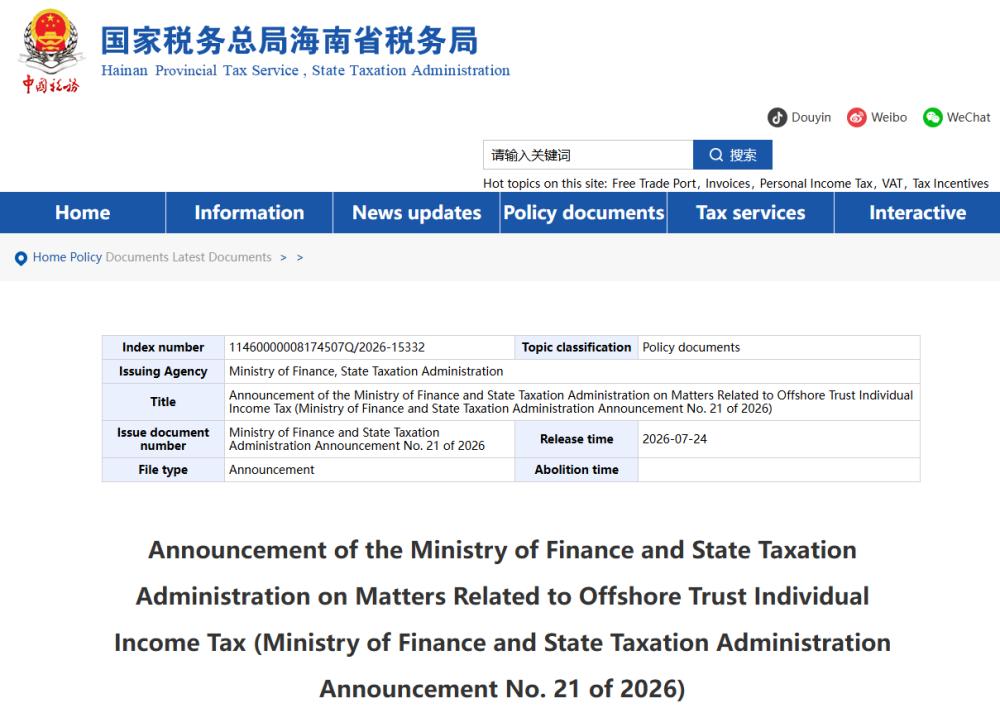
Note: For specific regulations on offshore trust individual income tax, please refer to the "Announcement on Matters Concerning Individual Income Tax on Offshore Trusts" (Ministry of Finance and State Taxation Administration Announcement No. 21 of 2026). For reminders regarding late declarations, please refer to the "Reminder Regarding Tax Declaration Matters for Offshore Trusts" (State Taxation Administration, October 19, 2026).
Policy Core Logic
The core logic of the policy is straightforward: when a Chinese tax resident places assets into an offshore trust, it is deemed a transfer of property, subject to a 20% individual income tax under the category of "Income from Property Transfer." CRS 2.0 (Common Reporting Standard) has been officially implemented in the BVI and the Cayman Islands since January 1, 2026. Hong Kong plans to implement it in 2028, with automatic exchange of information starting in 2029. Underlying transparency is now irreversible, and the structural dividend maintained through "information asymmetry" has officially come to an end. Facing the inevitable trend of underlying transparency, macro-level observation has lost its meaning; the real breakthrough lies in practical execution.
Action 1: Conduct a "Look-Through" Structural Check-Up and Strip Away Ineffective Designs
In the past, many trust structures focused solely on the "facade" (confidentiality) while neglecting the "substance" (substantive operations). In the context of CRS 2.0, shell structures lacking commercial substance and existing purely for tax avoidance purposes (especially underlying BVI companies) are highly susceptible to look-through identification.
Solution: Re-examine the trust deed and the substance of the underlying companies. Ensure the structure has legitimate commercial purposes, actual operating activities, or clear asset-holding logic. Do not leave obvious flaws in the structure that suggest "tax avoidance for the sake of tax avoidance." Substantive compliance over form is the first step to avoiding focused regulatory scrutiny.

Action 2: "Decoupled" Planning of Tax Residency and Succession Pathways
Many clients mistakenly believe that obtaining an overseas green card or passport automatically exempts them from Chinese tax residency obligations. In reality, the criteria for determining tax residency are based on "domicile" and "duration of residence," rather than nationality alone.
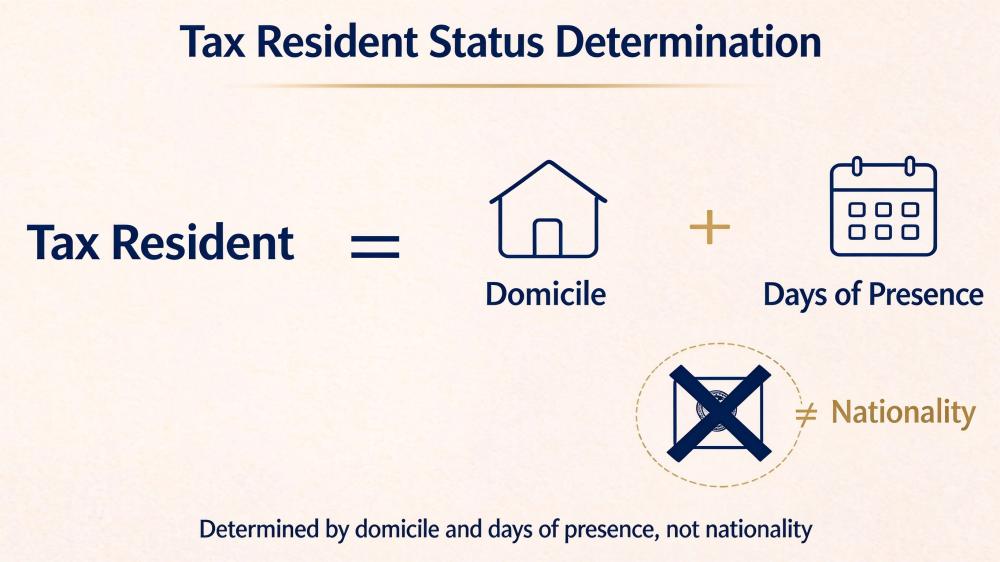
Solution: If you have children studying overseas or family members with cross-border lifestyle arrangements, it is necessary to re-evaluate tax residency status based on their actual days of residence and the location of core family assets. Hong Kong residency planning and tax arrangement possess immense practical value at this juncture—Hong Kong not only has a simple tax regime (no capital gains tax, no inheritance tax) but also has a double taxation avoidance arrangement with Mainland China. This can alleviate the double taxation pressure for certain family members following a change in status, thereby coordinating the succession pathway.
Action 3: Calculate the "Tax Base" and Mitigate Liquidity Risks in Advance
The 20% tax rate is a tangible cost. For families with illiquid underlying assets (such as unlisted equity or real estate), an unexpected large tax supplementation requirement can easily force the distressed sale of high-quality assets.
Solution: Immediately assess the liquidity of underlying assets. Anticipate future tax expenditures by reserving sufficient cash flow or allocating highly liquid assets in advance. For assets that require restructuring or liquidation, formulate a phased tax payment plan based on the tax base cost and current market valuation to avoid triggering a chain reaction of discounted sell-offs.
Note: For specific standards regarding the tax recovery period, late payment penalties, and the determination of tax evasion, please refer to Articles 32, 52, and 63 of the "Law of the People's Republic of China on the Administration of Tax Collection."
Conclusion
The "wild west" era of offshore trusts has come to an end. In this new cycle, compliance is no longer a cost, but the most solid moat for family wealth. For families that have already established or are considering establishing offshore trusts, understanding the underlying logic of look-through supervision and proactively reviewing the rationality and risk resistance of existing structures holds far greater long-term value than reacting passively.

The information contained in this document has been prepared based on publicly available information. des Voeux Partners Limited ("DVP") in preparing this document, and des Voeux Family Office Limited ("DVFO") in reproducing this document, have taken reasonable care to ensure that the information contained herein is accurate and objective. However, neither DVP nor DVFO makes any representation or warranty as to the accuracy or completeness of the information contained in this document (including any valuation mentioned herein), nor has any independent verification of such information been conducted. DVP makes no representation or warranty as to the adequacy, completeness, or suitability of this document for any particular purpose.This document merely provides a macroeconomic overview of recent economic and market developments and is intended solely for marketing and reference purposes. This document is not an investment research report, nor should it be regarded as investment research. The preparation of this document has not complied with legal requirements intended to promote the independence of investment research, nor is it subject to any prohibition on dealing ahead of the dissemination of investment research. Unless otherwise specified, the source of information contained in this document is DVP. The opinions expressed herein represent the views of the author as of the date of writing and are subject to change at any time without prior notice. Any forecasts, estimates, or targets mentioned in this document are for reference only and are not guaranteed to be achieved. DVP and the author assume no liability for any failure to achieve such forecasts, estimates, or targets. In the event of any discrepancy or inconsistency between the Chinese and English versions of this document, the English version shall prevail.No person should rely solely on the contents of this document to make any investment or other decisions. All relevant decisions should be based on your independent judgment and after consulting appropriate professional advisers.This document does not constitute an offer or invitation to buy or sell any securities, financial instruments, or other investment products by DVP or its affiliates, nor does it constitute any investment, accounting, legal, or tax advice. The contents of this document shall not be regarded as investment advice, an offer, or a solicitation provided to any individual.Investing in any products mentioned in this document involves varying degrees of risk, including credit risk, market risk, liquidity risk, legal risk, cross-jurisdictional risk, foreign exchange risk, and other risks associated with electronic trading and leveraged product trading. Investment inherently carries risk, and you may not recover your full principal amount invested. Prices of investment products may fluctuate significantly, going up or down, and may even become valueless. Buying and selling investment products carries the risk of incurring losses rather than making profits.Nothing in this document constitutes personalized accounting, legal, regulatory, tax, financial, or other professional advice tailored to the personal circumstances of the reader. Before investing in any product, you should consult your own financial, legal, tax, or other professional advisers to fully understand the relevant risks and assess whether you are suited to bear such risks.All descriptions of any investment products herein are subject to the terms and conditions of the respective investment product and, where applicable, the prospectus or other relevant offering documents accompanying such investment product.To the maximum extent permitted by applicable laws and regulations, DVP, DVFO, and their affiliates shall not be liable for any loss or damage of any kind arising from any action taken or not taken by any person in reliance upon any information, opinion, forecast, or valuation contained in this document, regardless of how such loss or damage arises.This document and its contents are intended solely for professional investors as defined in the Securities and Futures (Professional Investor) Rules (Cap. 571D) of Hong Kong. This document and its contents have not been reviewed by the Securities and Futures Commission of Hong Kong (SFC).