

On one side, consumption scenes are bustling; on the other, businesses are running on thin margins and households are hesitant to spend big. This peculiar phenomenon of "hot consumption, cold growth" has prompted deep reflection among high-net-worth individuals: in an era full of uncertainty, could our family wealth also fall into a trap of "looking prosperous, yet being fragile"?

Consumption willingness is never something that a subsidy policy alone can easily leverage; it depends on disposable income and future expectations.
Take a typical urban family as an example: a couple earning hundreds of thousands a year may look well-off, but rigid expenditures such as mortgages, children's education, and medical and retirement reserves are like several mountains that must be paid regardless of economic conditions.
Consumption vouchers can only pull next year's spending into this year; they cannot truly raise a family's long-term income. This offers a profound insight for high-net-worth families: without solid underlying assets and long-term cash flow planning, high surface-level income cannot mask financial fragility.
II. Why Do Thin Corporate Profits Affect You?
The macroeconomy does not exist in isolation; it is a transmission chain.
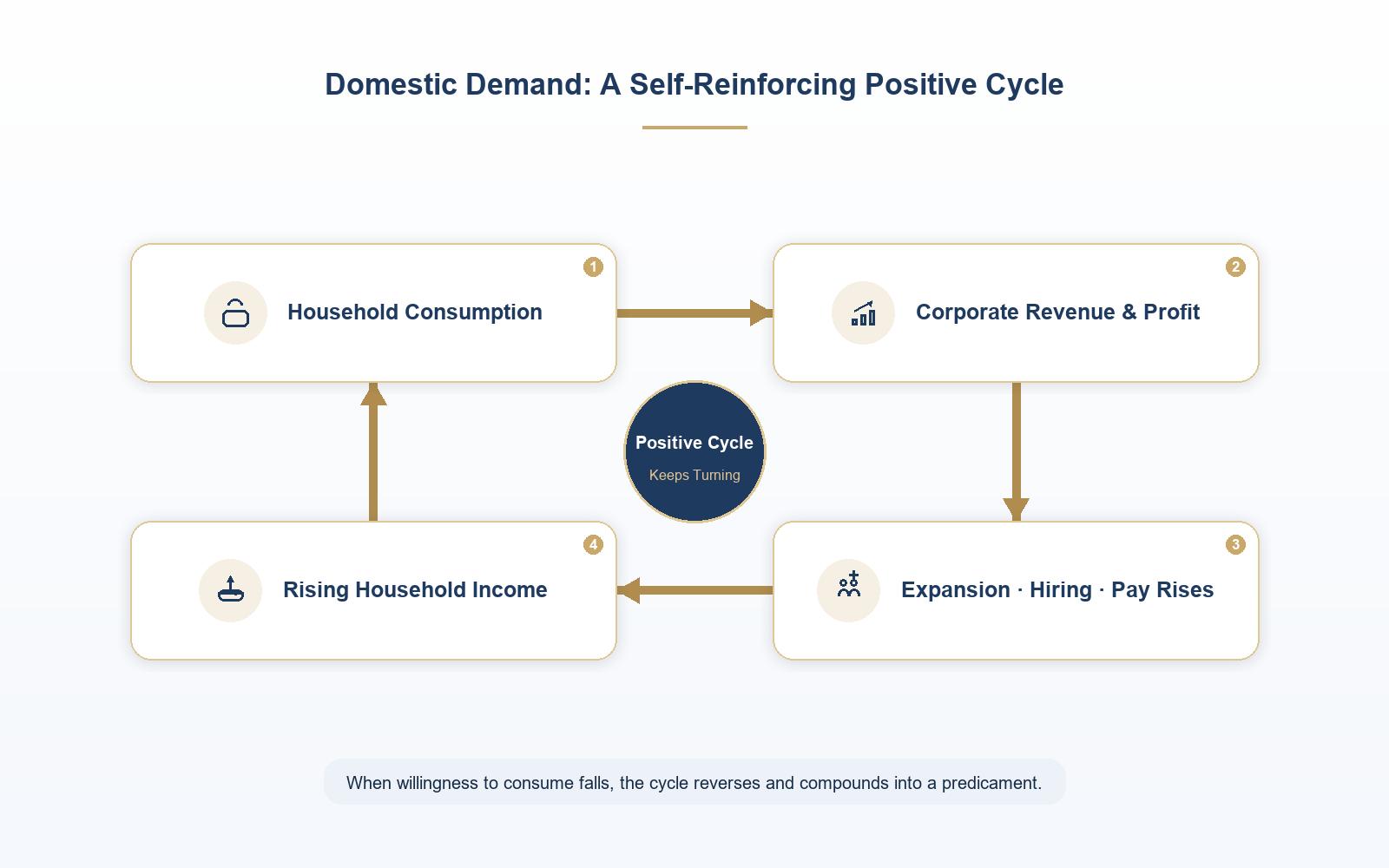
When overall demand weakens, businesses can only engage in price wars to compete for limited customers. Stores may be full, but per-customer profit is extremely low. As profits thin out, the most direct corporate response is to freeze salary increases or even reduce headcount. This directly feeds back into households' employment and income expectations. Feeling insecure, families save aggressively to guard against risks. Demand shrinks further, making it even harder for businesses, and a closed "negative loop" is formed.
Many high-net-worth individuals have realized at this stage that relying solely on short-term speculation not only makes it hard to achieve ideal returns but may also cause years of accumulation to shrink significantly if the cycle is mistimed.
III. The Breakthrough: From "Short-Term Stimulus" to "Long-Term Protection"
Short-term subsidies are like fever-reducing medicine—they treat the symptom, not the root cause. To truly break this cycle, the root must be repaired.
In fact, long-term management of family wealth faces the same principle. Focusing only on short-term high returns to "gamble" is like maintaining prosperity through consumption vouchers—it is rarely sustainable. To truly carry family wealth through cycles, a "positive loop" must be rebuilt from the source:
· Stabilize the foundation: Avoid blind expansion and do not take on risks beyond your capacity. Use scientific asset allocation to protect the family's core assets.
· Reduce the burden: Use tools such as insurance and family trusts to build firewalls in advance for children's education, parents' healthcare, and your own retirement, transferring uncertain rigid burdens away.
· Seek incremental growth: Within a compliant framework, deploy cross-border diversified assets to disperse systemic risks from a single market.

Conclusion
We cannot change the ups and downs of the macroeconomic environment, but the moat around family wealth can be built in advance.
Missing out on short-term policy dividends is not a problem; but without long-term structural planning, the "reservoir" of family wealth may slowly dry up.
No matter how economic cycles change, allowing wealth to return to long-term, steady, and secure principles is the "core asset" that high-net-worth families should hold on to most.
DISCLAIMER
The information contained in this document has been prepared based on publicly available information. des Voeux Partners Limited ("DVP") in preparing this document, and des Voeux Family Office Limited ("DVFO") in reproducing this document, have taken reasonable care to ensure that the information contained herein is accurate and objective. However, neither DVP nor DVFO makes any representation or warranty as to the accuracy or completeness of the information contained in this document (including any valuation mentioned herein), nor has any independent verification of such information been conducted. DVP makes no representation or warranty as to the adequacy, completeness, or suitability of this document for any particular purpose.This document merely provides a macroeconomic overview of recent economic and market developments and is intended solely for marketing and reference purposes. This document is not an investment research report, nor should it be regarded as investment research. The preparation of this document has not complied with legal requirements intended to promote the independence of investment research, nor is it subject to any prohibition on dealing ahead of the dissemination of investment research. Unless otherwise specified, the source of information contained in this document is DVP. The opinions expressed herein represent the views of the author as of the date of writing and are subject to change at any time without prior notice. Any forecasts, estimates, or targets mentioned in this document are for reference only and are not guaranteed to be achieved. DVP and the author assume no liability for any failure to achieve such forecasts, estimates, or targets. In the event of any discrepancy or inconsistency between the Chinese and English versions of this document, the English version shall prevail.No person should rely solely on the contents of this document to make any investment or other decisions. All relevant decisions should be based on your independent judgment and after consulting appropriate professional advisers.This document does not constitute an offer or invitation to buy or sell any securities, financial instruments, or other investment products by DVP or its affiliates, nor does it constitute any investment, accounting, legal, or tax advice. The contents of this document shall not be regarded as investment advice, an offer, or a solicitation provided to any individual.Investing in any products mentioned in this document involves varying degrees of risk, including credit risk, market risk, liquidity risk, legal risk, cross-jurisdictional risk, foreign exchange risk, and other risks associated with electronic trading and leveraged product trading. Investment inherently carries risk, and you may not recover your full principal amount invested. Prices of investment products may fluctuate significantly, going up or down, and may even become valueless. Buying and selling investment products carries the risk of incurring losses rather than making profits.Nothing in this document constitutes personalized accounting, legal, regulatory, tax, financial, or other professional advice tailored to the personal circumstances of the reader. Before investing in any product, you should consult your own financial, legal, tax, or other professional advisers to fully understand the relevant risks and assess whether you are suited to bear such risks.All descriptions of any investment products herein are subject to the terms and conditions of the respective investment product and, where applicable, the prospectus or other relevant offering documents accompanying such investment product.To the maximum extent permitted by applicable laws and regulations, DVP, DVFO, and their affiliates shall not be liable for any loss or damage of any kind arising from any action taken or not taken by any person in reliance upon any information, opinion, forecast, or valuation contained in this document, regardless of how such loss or damage arises.This document and its contents are intended solely for professional investors as defined in the Securities and Futures (Professional Investor) Rules (Cap. 571D) of Hong Kong. This document and its contents have not been reviewed by the Securities and Futures Commission of Hong Kong (SFC).
- Previous: 没有了!
- Next: High-Net-Worth Capital Returns to Hong Kong: Dual-Track Allocation of Consumption and Assets2026-11-17