

Open an AI tool to generate an image or a short video, and behind the screen, tens of thousands of GPUs are drawing power continuously. Many assume AI competition hinges on chips, algorithms, and parameters. But a recent investment has prompted the market to revisit the underlying logic of this race.
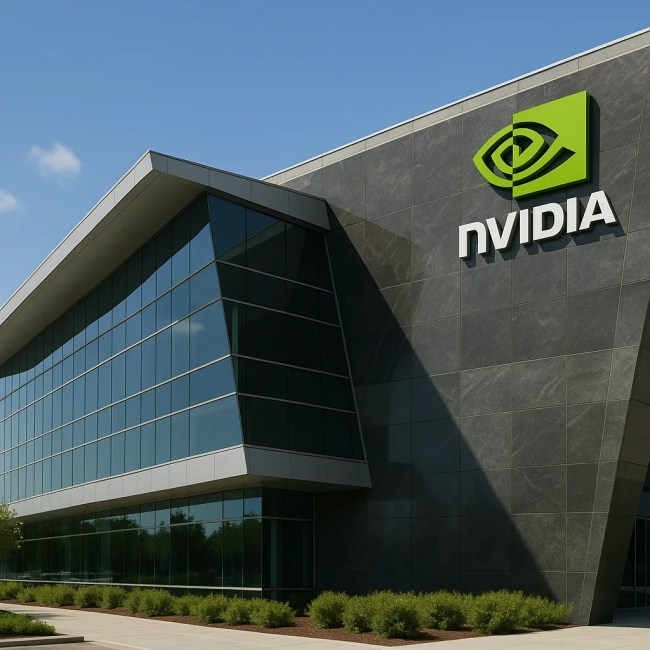
In late August, Nvidia announced an investment of up to US$3 billion in Lancium, a U.S. power infrastructure developer. The initial tranche of US$2 billion secures roughly a 20% stake, with an additional US$1 billion to follow once key grid-connection milestones are reached. The capital is earmarked for power infrastructure supporting OpenAI's Stargate AI campus. A company long focused on chips moving directly into power infrastructure investment carries notable signal value. The notion that "the compute bottleneck lies not in chips, but in power" is shifting from analytical judgment to a reality backed by capital.
I. AI Power Demand Surges, Traditional Grids Struggle to Keep Pace
Traditional data centers consume power at a relatively moderate pace; servers can reduce load at night and during holidays. The AI era is different. Large-model training requires 7×24 full-load operation, while inference workloads produce instantaneous power spikes.
The power consumption of a single AI server rack is roughly equivalent to that of over a hundred households drawing power simultaneously. AI compute clusters impose three hard requirements on power supply: stability without interruption, controllable electricity costs, and compliance with increasingly stringent carbon emission standards. Yet existing grid planning frameworks did not anticipate the concentrated power pressure that AI would bring.
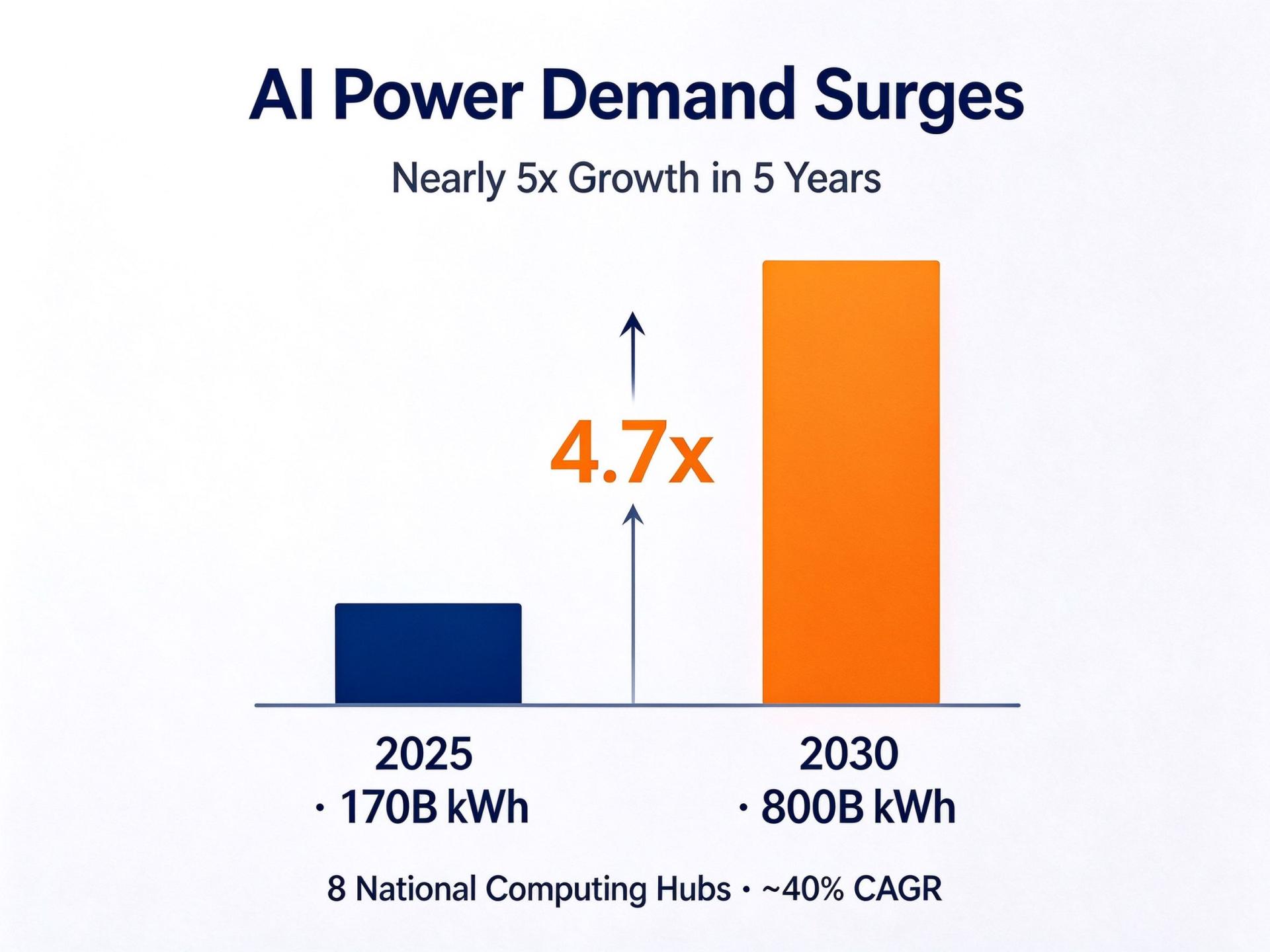
According to estimates by China's National Energy Administration, power consumption at China's eight national computing hub nodes has grown at an average annual rate of nearly 40% over the past three years, markedly outpacing the average growth rate of society-wide electricity consumption. In 2025, national computing centers consumed approximately 170 billion kWh; according to industry forecasts, this figure could reach 800 billion kWh by 2030.
Against this demand growth, the traditional power supply model faces three structural shortcomings: grid-connection queues, with new data centers in North America typically waiting three to five years for grid connection—equipment purchased but power unavailable; electricity costs, with power accounting for over half of operating costs at many intelligent computing centers, forcing smaller operators to exit; and green power mismatch, with abundant wind and solar resources in the west but insufficient local absorption, while eastern compute clusters lack nearby green power.
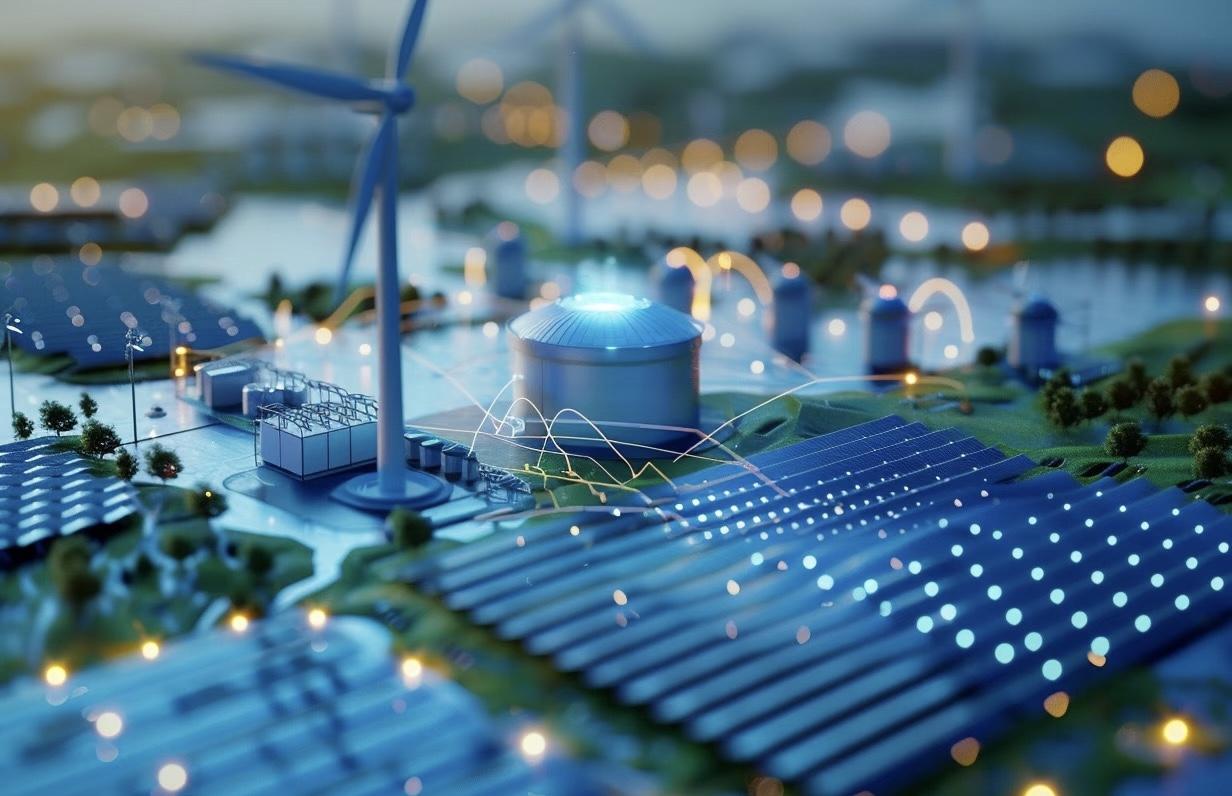
Traditional large-scale centralized grids struggle to fully resolve this spatial and temporal mismatch. Integrated wind-solar-storage-diesel microgrids, which can connect to the main grid or operate independently, are emerging as an important direction.
II. Four Global Pathways, Four Approaches
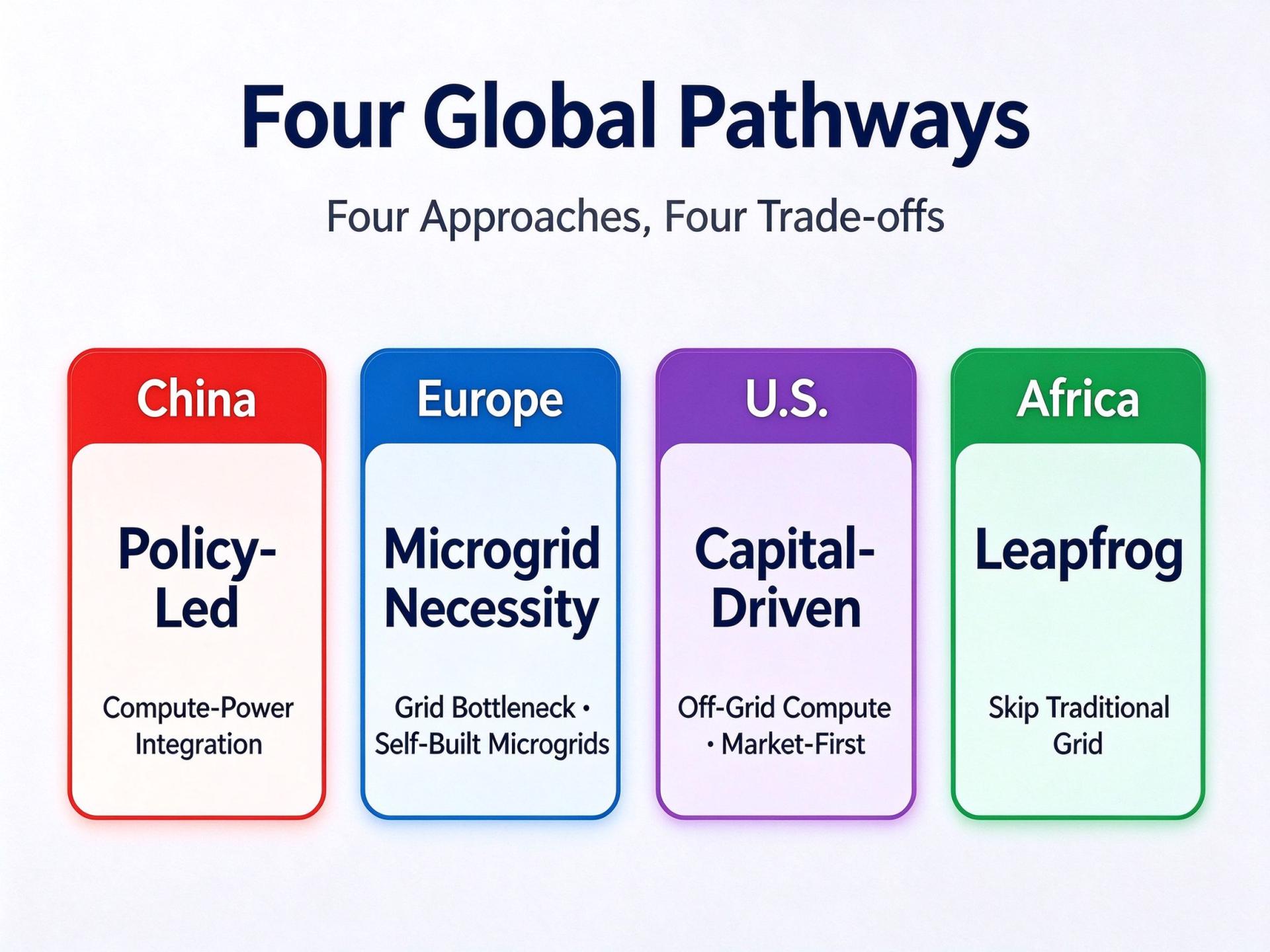
China:Policy-led, bidirectional compute-power integration.
In 2026, compute-power coordination was incorporated into China's Government Work Report, the 15th Five-Year Plan outline, and the 15th Five-Year Plan for the New Energy System. The National Data Administration of China defines it as: relying on digital technology and intelligent scheduling to unify planning and coordinated operation of computing infrastructure and new power systems, creating a virtuous cycle of "power empowering compute, compute promoting power." During peak demand, non-urgent AI tasks can be dispatched to power-surplus regions; when wind and solar generation is high, more compute tasks can run to absorb excess power. The advantage lies in strong coordination capacity and scalable implementation. The challenge lies in multi-party coordination, with implementation details still requiring refinement.
Europe:Grid bottlenecks force microgrids from option to necessity.
Europe's grids are aging, retrofit timelines are long, and grid-connection approvals are stringent. The AI compute surge further strains already tight grid capacity. A growing number of projects opt for self-built microgrids, bypassing lengthy queue approvals while meeting low-carbon requirements. Siemens, ABB, and Schneider Electric are stepping up investment in microgrid equipment, storage, and energy management systems. The shortcoming is fragmentation—lack of unified standards and national-level coordination.
United States:Capital-driven, off-grid compute leads the way.
The U.S. encountered the compute-energy conflict earlier, addressing it on two fronts: upward control of energy resources and critical minerals, and downward cultivation of a market-driven off-grid microgrid ecosystem. On the industry side, Crusoe Energy focuses on "off-grid microgrids plus flexible compute scheduling," bypassing grid-connection queues, with a valuation exceeding US$10 billion. Nvidia's investment in Lancium extends this same logic. The advantage is a mature commercialclosed loopand high capital efficiency. The shortcoming is that quality projects concentrate in the private campuses of a few leading tech giants, limiting inclusivity.
Africa:Late-mover market, leapfrogging traditional grids.
More than 600 million people in Africa still lack access to the main grid. Traditional high-voltage large grids require massive investment and long construction cycles, whereas solar-plus-storage microgrids offer flexible deployment and rapid construction, becoming a core solution. In 2026, the World Bank launched the DARES project in Nigeria, with US$750 million in financing plus US$150 million in performance grants, targeting the replacement of 280,000 polluting diesel generators. The project extensively uses inverters, lithium iron phosphate batteries, and energy management systems from Chinese supply chains. More notably, the possibility of a localized "minerals + new energy + compute" closed loop creates new opportunities for local processing and local compute development. The challenges are tangible: funding gaps, local talent shortages, and channel development.
III. The Long-Term Value of Compute-Power Coordination
Nvidia's US$3 billion investment conveys a signal beyond an ordinary financial investment. Compute competition is extending downward to the power layer. The ability to secure power infrastructure that is reliably delivered, flexibly dispatched, and low-carbon is seeing its strategic status converge with that of advanced chips.
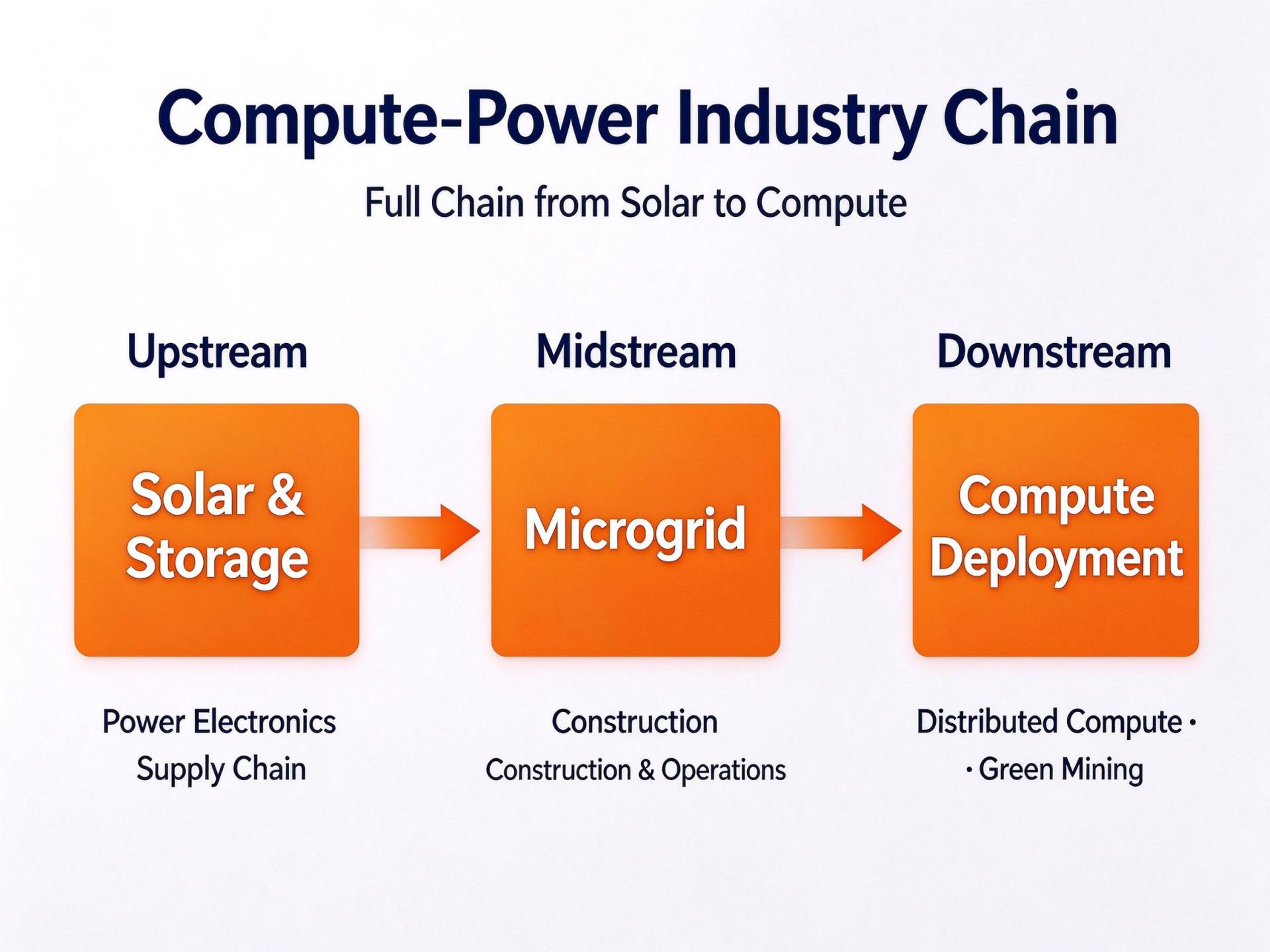
For long-term capital, compute-power coordination is no longer merely a concept, but an industrial track generating real cash flows. Upstream lies the photovoltaic, storage, and power electronics equipment supply chain; midstream comprises microgrid engineering, operation, and dispatch services; downstream extends to distributed compute deployment, green mining support, and other scenarios.
For the general public, electricity costs are the underlying cost of AI services. When compute-power coordination drives down the cost of compute electricity, the price of using large models, AI drawing, and AI video tools may become more accessible, further democratizing AI technology; at the same time, fully absorbing wind and solar clean energy reduces carbon emissions and brings a better ecological environment.
DISCLAIMER
The information contained in this document has been prepared based on publicly available information. des Voeux Partners Limited ("DVP") in preparing this document, and des Voeux Family Office Limited ("DVFO") in reproducing this document, have taken reasonable care to ensure that the information contained herein is accurate and objective. However, neither DVP nor DVFO makes any representation or warranty as to the accuracy or completeness of the information contained in this document (including any valuation mentioned herein), nor has any independent verification of such information been conducted. DVP makes no representation or warranty as to the adequacy, completeness, or suitability of this document for any particular purpose.This document merely provides a macroeconomic overview of recent economic and market developments and is intended solely for marketing and reference purposes. This document is not an investment research report, nor should it be regarded as investment research. The preparation of this document has not complied with legal requirements intended to promote the independence of investment research, nor is it subject to any prohibition on dealing ahead of the dissemination of investment research. Unless otherwise specified, the source of information contained in this document is DVP. The opinions expressed herein represent the views of the author as of the date of writing and are subject to change at any time without prior notice. Any forecasts, estimates, or targets mentioned in this document are for reference only and are not guaranteed to be achieved. DVP and the author assume no liability for any failure to achieve such forecasts, estimates, or targets. In the event of any discrepancy or inconsistency between the Chinese and English versions of this document, the English version shall prevail.No person should rely solely on the contents of this document to make any investment or other decisions. All relevant decisions should be based on your independent judgment and after consulting appropriate professional advisers.This document does not constitute an offer or invitation to buy or sell any securities, financial instruments, or other investment products by DVP or its affiliates, nor does it constitute any investment, accounting, legal, or tax advice. The contents of this document shall not be regarded as investment advice, an offer, or a solicitation provided to any individual.Investing in any products mentioned in this document involves varying degrees of risk, including credit risk, market risk, liquidity risk, legal risk, cross-jurisdictional risk, foreign exchange risk, and other risks associated with electronic trading and leveraged product trading. Investment inherently carries risk, and you may not recover your full principal amount invested. Prices of investment products may fluctuate significantly, going up or down, and may even become valueless. Buying and selling investment products carries the risk of incurring losses rather than making profits.Nothing in this document constitutes personalized accounting, legal, regulatory, tax, financial, or other professional advice tailored to the personal circumstances of the reader. Before investing in any product, you should consult your own financial, legal, tax, or other professional advisers to fully understand the relevant risks and assess whether you are suited to bear such risks.All descriptions of any investment products herein are subject to the terms and conditions of the respective investment product and, where applicable, the prospectus or other relevant offering documents accompanying such investment product.To the maximum extent permitted by applicable laws and regulations, DVP, DVFO, and their affiliates shall not be liable for any loss or damage of any kind arising from any action taken or not taken by any person in reliance upon any information, opinion, forecast, or valuation contained in this document, regardless of how such loss or damage arises.This document and its contents are intended solely for professional investors as defined in the Securities and Futures (Professional Investor) Rules (Cap. 571D) of Hong Kong. This document and its contents have not been reviewed by the Securities and Futures Commission of Hong Kong (SFC).
- Previous: A Family's True Bedrock: Six Invisible Assets2026-10-09
- Next: des Voeux Insights | AI Monetization Accelerates as Hardware Emerges as the Ballast of the Compute Era2026-10-06