


With almost identical overseas expansion stories, why have Japanese consumer companies been able to sustain profitability and long-term stock price growth?
Beyond macroeconomic reflation factors, there are two more critical reasons.
Before delving into them, we must first understand that a consumer company's revenue and profit come from two sources: same-store sales from existing stores, and the incremental revenue and losses generated by new store expansion.
Returning to the China-Japan comparison:
1. Japanese companies pursue the "single-store effect," avoiding blind expansion in a land-grab manner. They strive to make every new store profitable, turning it into a new profit center rather than a loss.
2. They choose long-term foundational positioning (timeless basics, cost-effectiveness, low-desire aesthetics) rather than short-term trends and stories.
This "slow" choice has allowed same-store sales to grow steadily, while new stores—both domestic and overseas—bring additional growth, translating into continuous profit recovery. This is why, even during the "lost 30 years," companies capable of navigating cycles and worth investing in could still emerge.
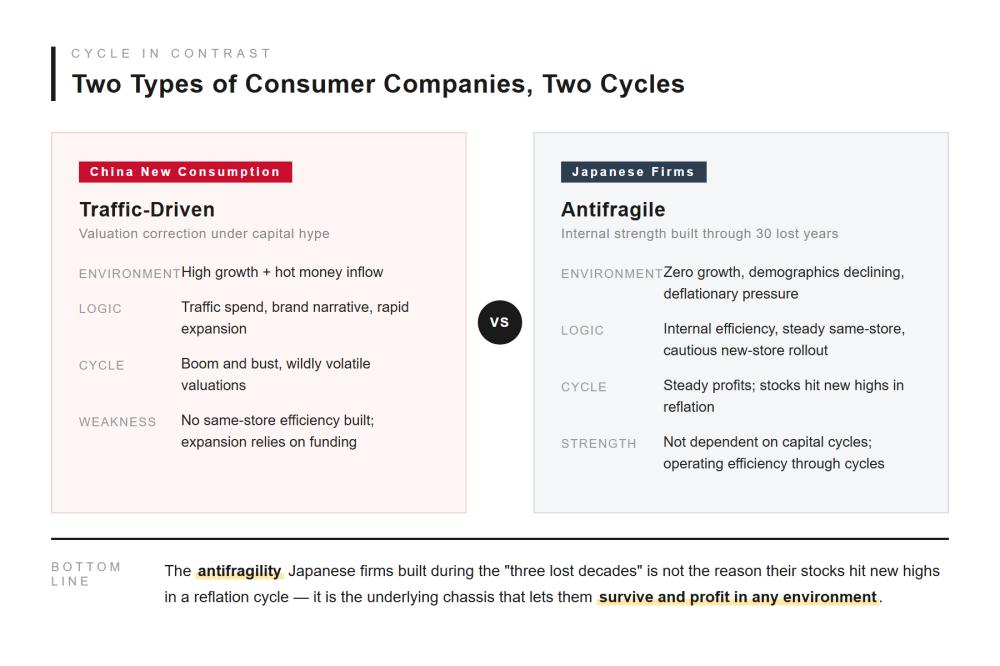
In summary, the 300% surge and 60% plunge of Chinese new consumer brands reflect the fate of "traffic-driven" companies under capital catalysis—when the story ends and same-store growth stalls, valuations undergo a brutal reversion.
What Japanese companies learned during their "lost 30 years" is how to earn "hard-won profits" in a zero-growth environment by improving internal efficiency, stabilizing same-store sales, and cautiously replicating new stores. This anti-fragility honed in adversity is precisely the underlying logic that has enabled their stock prices to continuously reach new highs during the global reflation and yen asset revaluation cycle.
Japanese companies avoid blind expansion because their scrutiny of opening a new store is extremely rigorous. The domestic market is mature and saturated, with high labor and rental costs, which forces Japanese companies to develop exceptionally strong single-store profitability models domestically.
Take Uniqlo as an example. Its overseas expansion involves replicating standardized store operation procedures (from product display and service to inventory turnover) globally, minimizing the "loss period" of new stores. In contrast, some Chinese new consumer brands rely heavily on a "franchisee land-grab" model of rapid expansion. Once the market saturates or consumer enthusiasm fades, franchisees become unprofitable, triggering a chain collapse.
2. Behind "Foundational Positioning": Supply Chains That Cross Cycles
The basics of Uniqlo and the low-desire aesthetic of MUJI offer a financial advantage of extremely low inventory obsolescence risk and high supply chain bargaining power. HEATTECH, AIRism, and other technical fabrics can sell for ten or twenty years, meaning the supply chain does not need to frequently change molds or fabrics to chase short-term trends. This allows procurement costs for a single category to be minimized while maintaining stable gross margins. Conversely, categories with strong trend attributes or emotional value face significant pressure on same-store sales once consumers experience aesthetic fatigue or consumer confidence fluctuates.
3. The Essential Difference in Overseas Expansion: Glocalization vs. Traffic Harvesting
Japanese brands' overseas expansion is "long-termism." When MUJI and Uniqlo enter European, American, or Southeast Asian markets, they often spend years adjusting sizes and fits, even collaborating with local designers, to internalize the brand as part of the local middle class's daily lifestyle. In contrast, the overseas expansion of some Chinese brands is largely about propping up "valuation imagination space" after domestic saturation. Initially, they experience explosive growth driven by novelty and the overseas Chinese demographic dividend. However, when it comes to truly entering local mainstream culture and facing multinational compliance and localized operations, they often lack staying power.
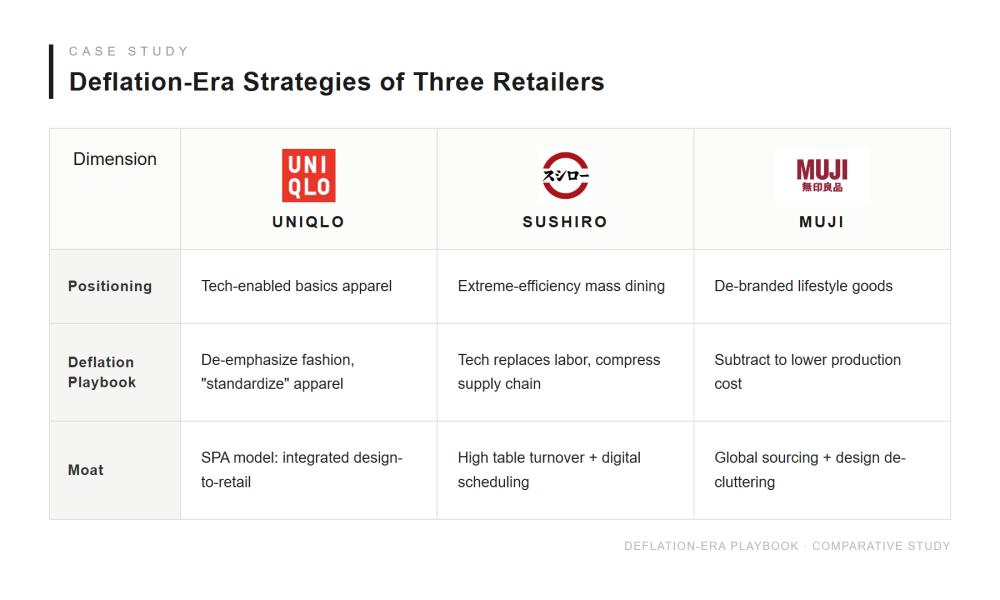
· Uniqlo's core strategy is an asset-based transformation that counters the apparel fashion cycle.
Over 70% of its styles are evergreen items with long lifecycles, greatly reducing clearance losses from fashion misjudgments. Through collaborations with material giants, it uses features like "warmth" and "quick-dry" to define products, making consumers perceive functional value beyond price. The SPA model controls every step from raw materials to the terminal, achieving a cost moat.

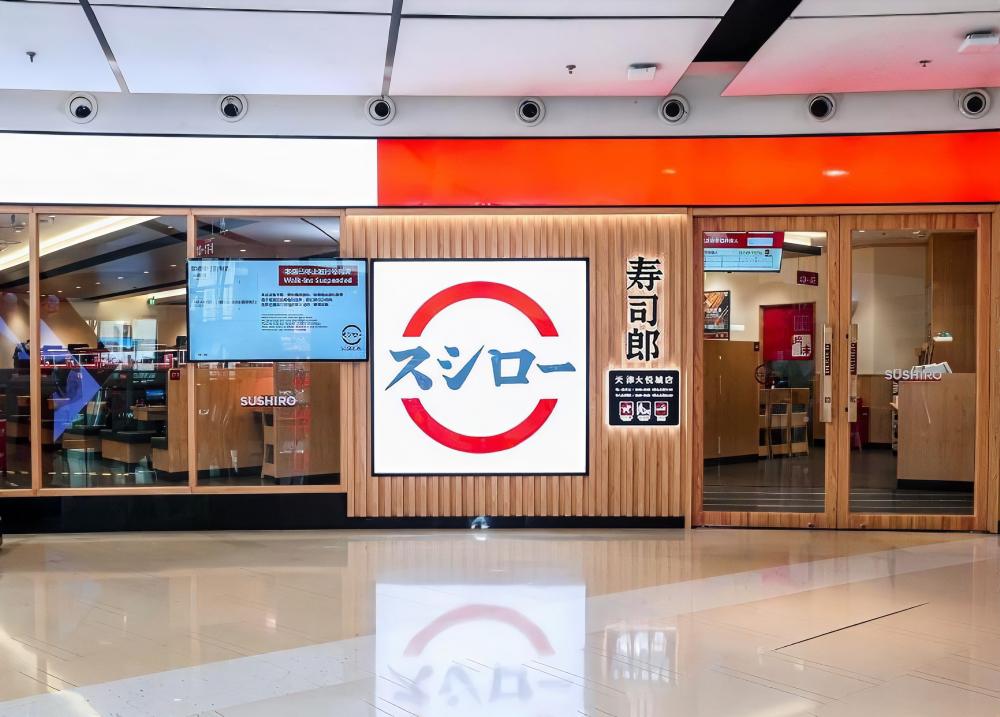
· Sushiro is a projection of precision industrial engineering onto the restaurant industry.
IC chip conveyor belts, automatic rice ball machines, and touchscreen ordering keep waste rates extremely low. Global direct procurement and proprietary logistics maintain food cost ratios at a relatively high industry level, penetrating consumer mindsets at the terminal with a price of "100 yen per plate." When family budgets tighten, it becomes a "dining-out substitute" for middle-class families.
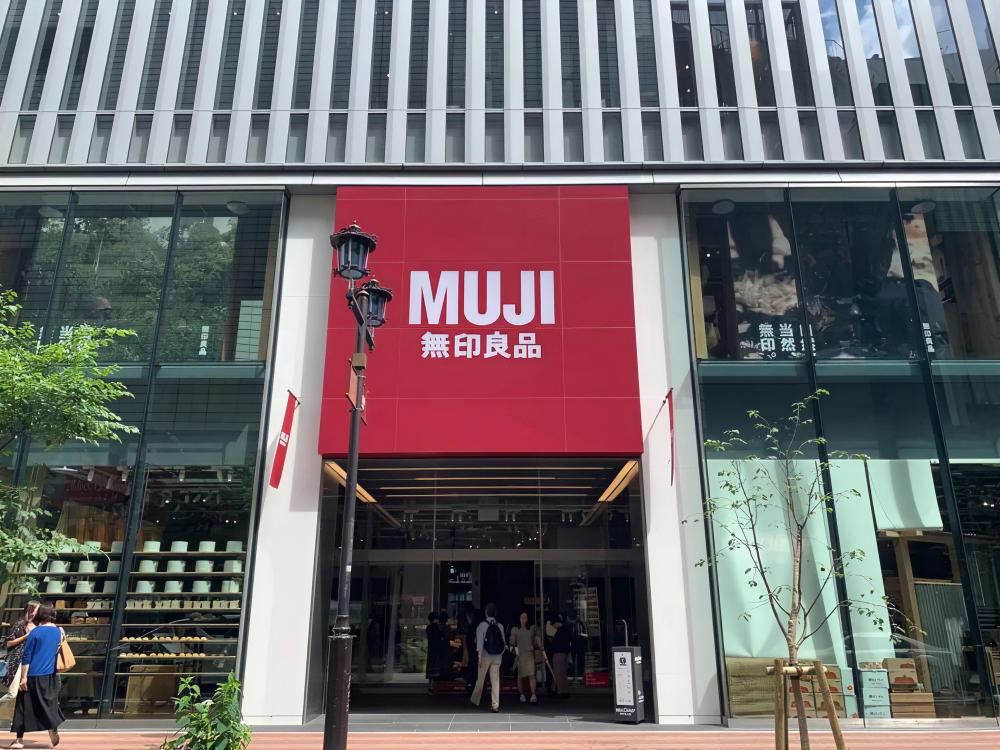
· MUJI's core logic is de-vanity.
By eliminating unnecessary packaging, refusing brand logos, and retaining the original color of materials, packaging and processing costs are minimized. Through global sourcing of high-quality alternative raw materials, it provides consumers with a "dignified, simple lifestyle." From stationery and clothing to home furnishings and food, MUJI has built a complete lifestyle loop for the low-desire era, increasing repurchase frequency.
DISCLAIMER
The information contained in this document has been prepared based on publicly available information. des Voeux Partners Limited ("DVP") in preparing this document, and des Voeux Family Office Limited ("DVFO") in reproducing this document, have taken reasonable care to ensure that the information contained herein is accurate and objective. However, neither DVP nor DVFO makes any representation or warranty as to the accuracy or completeness of the information contained in this document (including any valuation mentioned herein), nor has any independent verification of such information been conducted. DVP makes no representation or warranty as to the adequacy, completeness, or suitability of this document for any particular purpose.This document merely provides a macroeconomic overview of recent economic and market developments and is intended solely for marketing and reference purposes. This document is not an investment research report, nor should it be regarded as investment research. The preparation of this document has not complied with legal requirements intended to promote the independence of investment research, nor is it subject to any prohibition on dealing ahead of the dissemination of investment research. Unless otherwise specified, the source of information contained in this document is DVP. The opinions expressed herein represent the views of the author as of the date of writing and are subject to change at any time without prior notice. Any forecasts, estimates, or targets mentioned in this document are for reference only and are not guaranteed to be achieved. DVP and the author assume no liability for any failure to achieve such forecasts, estimates, or targets. In the event of any discrepancy or inconsistency between the Chinese and English versions of this document, the English version shall prevail.No person should rely solely on the contents of this document to make any investment or other decisions. All relevant decisions should be based on your independent judgment and after consulting appropriate professional advisers.This document does not constitute an offer or invitation to buy or sell any securities, financial instruments, or other investment products by DVP or its affiliates, nor does it constitute any investment, accounting, legal, or tax advice. The contents of this document shall not be regarded as investment advice, an offer, or a solicitation provided to any individual.Investing in any products mentioned in this document involves varying degrees of risk, including credit risk, market risk, liquidity risk, legal risk, cross-jurisdictional risk, foreign exchange risk, and other risks associated with electronic trading and leveraged product trading. Investment inherently carries risk, and you may not recover your full principal amount invested. Prices of investment products may fluctuate significantly, going up or down, and may even become valueless. Buying and selling investment products carries the risk of incurring losses rather than making profits.Nothing in this document constitutes personalized accounting, legal, regulatory, tax, financial, or other professional advice tailored to the personal circumstances of the reader. Before investing in any product, you should consult your own financial, legal, tax, or other professional advisers to fully understand the relevant risks and assess whether you are suited to bear such risks.All descriptions of any investment products herein are subject to the terms and conditions of the respective investment product and, where applicable, the prospectus or other relevant offering documents accompanying such investment product.To the maximum extent permitted by applicable laws and regulations, DVP, DVFO, and their affiliates shall not be liable for any loss or damage of any kind arising from any action taken or not taken by any person in reliance upon any information, opinion, forecast, or valuation contained in this document, regardless of how such loss or damage arises.This document and its contents are intended solely for professional investors as defined in the Securities and Futures (Professional Investor) Rules (Cap. 571D) of Hong Kong. This document and its contents have not been reviewed by the Securities and Futures Commission of Hong Kong (SFC).