

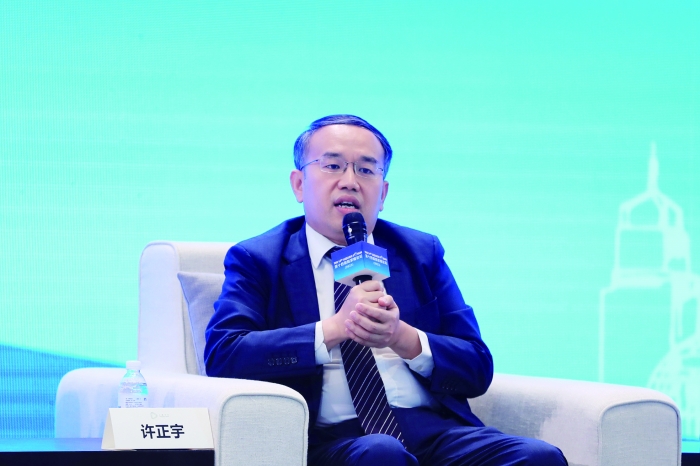
On October 23, Christopher Hui, Secretary for Financial Services and the Treasury of Hong Kong, confirmed that Hong Kong will further optimize the preferential tax regime for family offices. The most significant change in this adjustment is the official inclusion of "digital assets" and "precious metals" in the list of qualifying investments eligible for family office tax exemptions.
This policy sends an extremely clear and substantive signal: under a compliant structure in Hong Kong, allocating gold and digital assets through a Family-owned Investment Holding Vehicle (FIHV) will, in most cases, no longer be subject to capital gains tax.
I. The Bottom Line: What Does This Actually Mean?
Hong Kong does not impose capital gains tax or inheritance tax to begin with. However, this is conditional on the transaction being conducted within a specific compliant structure (for example, establishing an FIHV managed by a single family office).
· Previously, many clients held gold at private banks and digital assets on exchanges. Where high-frequency trading generated substantial profits, there was often ambiguity in tax treatment.
· Now, the policy is explicit: as long as the assets are held within a compliant FIHV that meets the substantive activity requirements, profits from these two asset classes are directly eligible for tax exemption.
This means that, within a compliant framework, the operational scope for gold as an inflation hedge and digital assets as a high-elasticity alternative allocation is further opened up, without excessive concern over "paying a large tax bill on profits." At the same time, the policy also brings private credit and certain loans into the exemption scope, providing more room for tax optimization in fixed-income investments.

II. Why Is Hong Kong Doing This Now?
The data speaks for itself. Currently, there are more than 3,380 single family offices established in Hong Kong, representing growth of over 25% in two years and generating approximately HKD 12.6 billion in annual economic benefits for Hong Kong.
Hong Kong's objective is clear: to attract at least 220 additional family offices to establish or expand in the city between 2026 and 2028. Facing competition from Singapore, Dubai, and other jurisdictions, "tax exemption" alone is no longer sufficient—clients must have "somewhere to invest their money."
Bringing digital assets, gold, and private credit into the tax exemption toolbox is, in essence, Hong Kong signaling its attractiveness to global investors: "For emerging and safe-haven assets, Hong Kong's tax framework is the most favorable to you."

III. Objective Observations: The Compliance Thresholds Behind the Policy Dividend
For families that already hold or plan to include gold and digital assets, the new rules offer tax benefits while also imposing clearer compliance requirements. From the practice of Hong Kong tax supervision, the following points merit objective attention:
1.Alignment Between Structure and Assets: In the actual operation of offshore trusts or FIHVs, the clear definition of underlying asset classes is the foundation for tax concessions. If investment memoranda established earlier do not cover precious metals or digital assets, there may be differences in determination when applying for tax exemptions.
2.Hard Constraints of Substantive Activity Requirements: Tax exemption is not an "automatic entitlement" without thresholds. Under relevant Hong Kong regulations, an FIHV must satisfy the "substantive activity requirements" (such as maintaining real office premises in Hong Kong, employing local staff, and incurring local operating expenditure). Structures that are purely shell entities or lack substantive local operations will not only fail to qualify for tax exemption but may also face compliance risks from look-through supervision.
3.Licensing Requirements for Service Providers: With the implementation of the new rules, regulatory standards for compliant transactions and system connectivity have been further raised. In market practice, services provided by institutions holding Hong Kong SFC licenses with mature family office structure management capabilities are a core element in ensuring that asset allocation meets look-through regulatory requirements.
Note: For specific tax concession applications and substantive activity requirements, please refer to the Hong Kong Inland Revenue Department's guidelines on family-owned investment holding vehicles.

Conclusion
Tax rules are beginning to embrace new asset classes—a clear positive signal for investors with a global perspective. Placing assets within a compliant framework and letting the structure adapt to the assets is the truly efficient and secure approach to wealth management.
DISCLAIMER
The information contained in this document has been prepared based on publicly available information. des Voeux Partners Limited ("DVP") in preparing this document, and des Voeux Family Office Limited ("DVFO") in reproducing this document, have taken reasonable care to ensure that the information contained herein is accurate and objective. However, neither DVP nor DVFO makes any representation or warranty as to the accuracy or completeness of the information contained in this document (including any valuation mentioned herein), nor has any independent verification of such information been conducted. DVP makes no representation or warranty as to the adequacy, completeness, or suitability of this document for any particular purpose.This document merely provides a macroeconomic overview of recent economic and market developments and is intended solely for marketing and reference purposes. This document is not an investment research report, nor should it be regarded as investment research. The preparation of this document has not complied with legal requirements intended to promote the independence of investment research, nor is it subject to any prohibition on dealing ahead of the dissemination of investment research. Unless otherwise specified, the source of information contained in this document is DVP. The opinions expressed herein represent the views of the author as of the date of writing and are subject to change at any time without prior notice. Any forecasts, estimates, or targets mentioned in this document are for reference only and are not guaranteed to be achieved. DVP and the author assume no liability for any failure to achieve such forecasts, estimates, or targets. In the event of any discrepancy or inconsistency between the Chinese and English versions of this document, the English version shall prevail.No person should rely solely on the contents of this document to make any investment or other decisions. All relevant decisions should be based on your independent judgment and after consulting appropriate professional advisers.This document does not constitute an offer or invitation to buy or sell any securities, financial instruments, or other investment products by DVP or its affiliates, nor does it constitute any investment, accounting, legal, or tax advice. The contents of this document shall not be regarded as investment advice, an offer, or a solicitation provided to any individual.Investing in any products mentioned in this document involves varying degrees of risk, including credit risk, market risk, liquidity risk, legal risk, cross-jurisdictional risk, foreign exchange risk, and other risks associated with electronic trading and leveraged product trading. Investment inherently carries risk, and you may not recover your full principal amount invested. Prices of investment products may fluctuate significantly, going up or down, and may even become valueless. Buying and selling investment products carries the risk of incurring losses rather than making profits.Nothing in this document constitutes personalized accounting, legal, regulatory, tax, financial, or other professional advice tailored to the personal circumstances of the reader. Before investing in any product, you should consult your own financial, legal, tax, or other professional advisers to fully understand the relevant risks and assess whether you are suited to bear such risks.All descriptions of any investment products herein are subject to the terms and conditions of the respective investment product and, where applicable, the prospectus or other relevant offering documents accompanying such investment product.To the maximum extent permitted by applicable laws and regulations, DVP, DVFO, and their affiliates shall not be liable for any loss or damage of any kind arising from any action taken or not taken by any person in reliance upon any information, opinion, forecast, or valuation contained in this document, regardless of how such loss or damage arises.This document and its contents are intended solely for professional investors as defined in the Securities and Futures (Professional Investor) Rules (Cap. 571D) of Hong Kong. This document and its contents have not been reviewed by the Securities and Futures Commission of Hong Kong (SFC).