

From Single-Point Reliance to Synergistic Mechanisms: The Disruptive Value of the EAM Model
For a long time, high-net-worth clients have been accustomed to relying on a single private bank. However, the limitations of the traditional system are gradually becoming apparent: product access is relatively closed, and relationship managers' performance assessments are tied to institutional sales, making it difficult for them to remain completely neutral and conduct whole-market price comparisons from the client's perspective. Furthermore, when assets are scattered across multiple banks, clients often have to coordinate them themselves, resulting in high information asymmetry and communication costs. Today, facing complex needs that span markets and generations, clients require unified management of their family's entire balance sheet.
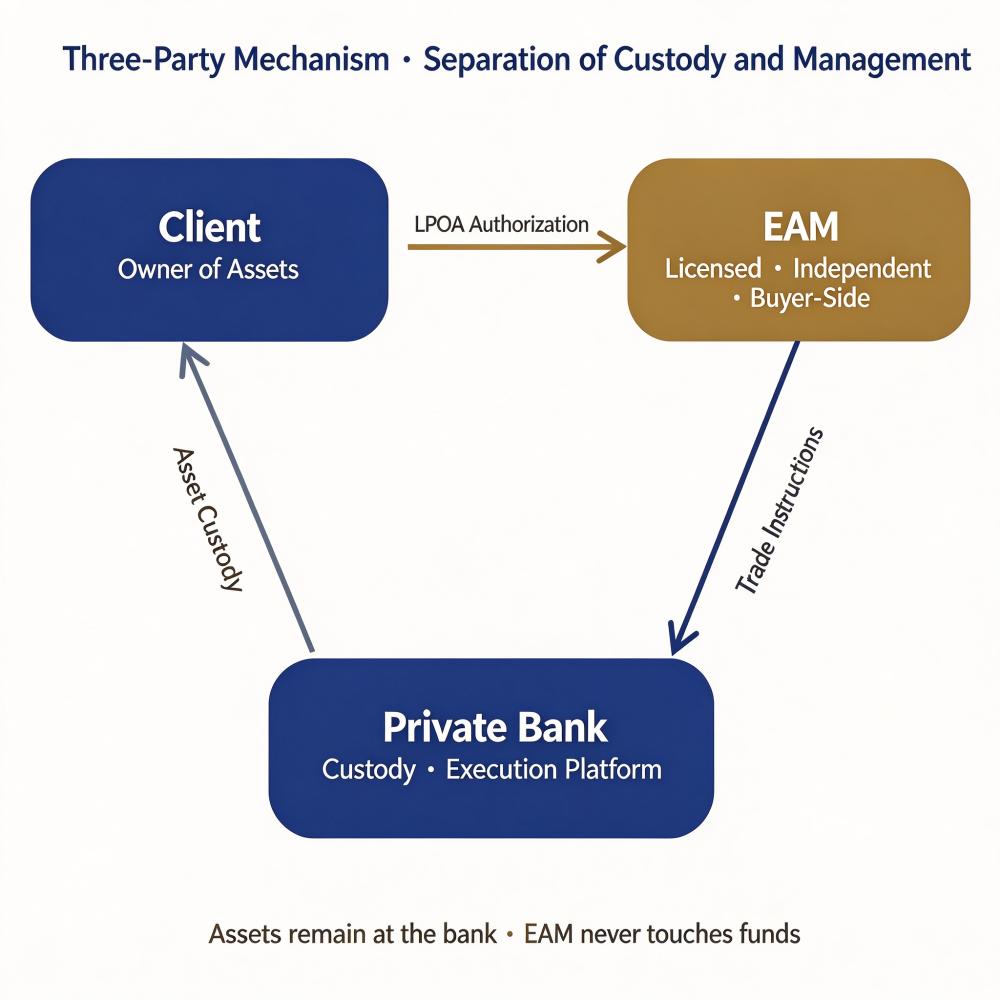
The EAM model precisely addresses these pain points. In terms of architectural design, assets remain in custody at the private bank, while the EAM acts solely as an independent advisor issuing investment instructions. This "assets don't move, but mechanisms add value" design preserves the security of private bank custody while empowering clients with the global vision of a "dedicated steward."
Because the EAM's revenue primarily comes from client service fees rather than product spreads, its stance is naturally deeply aligned with the client's interests. Through a "single window," it breaks down the product barriers of a single bank, conducting cross-bank price comparisons and horizontal selection. In this process, clients are no longer passive "business resources," but rather view the bank as a tool at their disposal. The EAM essentially extracts the "referee" role from the traditional model where the bank acts as both "player and referee," truly scrutinizing all sales processes on behalf of the client to achieve cost reduction, efficiency, and objective coordination.
Buy-Side Alignment vs. the Interest Structure of Traditional Private Banks
The product access and sales systems of traditional private banks are relatively closed, and relationship managers' performance assessments are linked to their institution's product issuance. EAMs, on the other hand, typically do not issue proprietary products; their revenue mainly comes from client service fees, positioning them closer to a buy-side advisor.
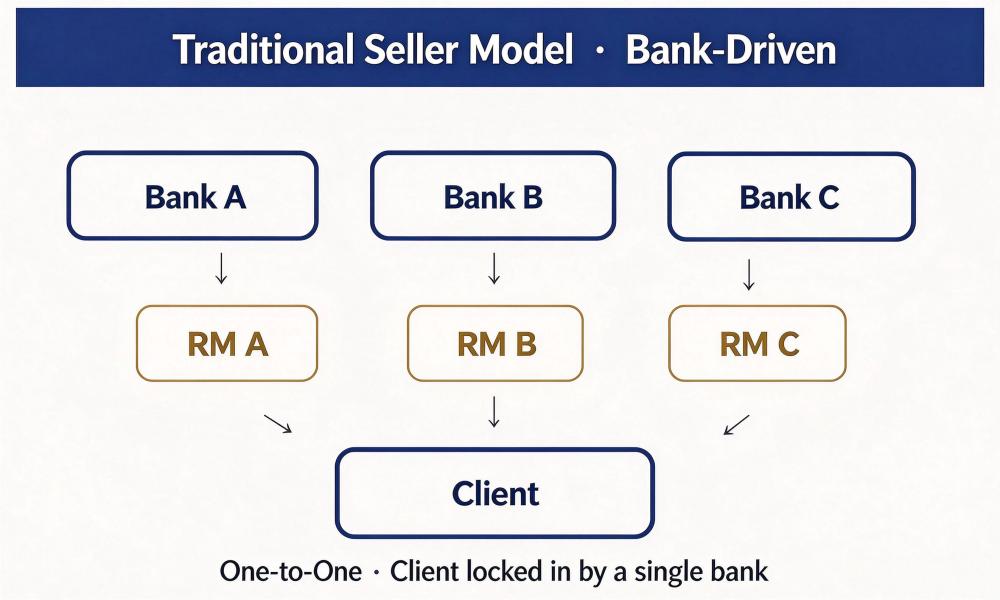
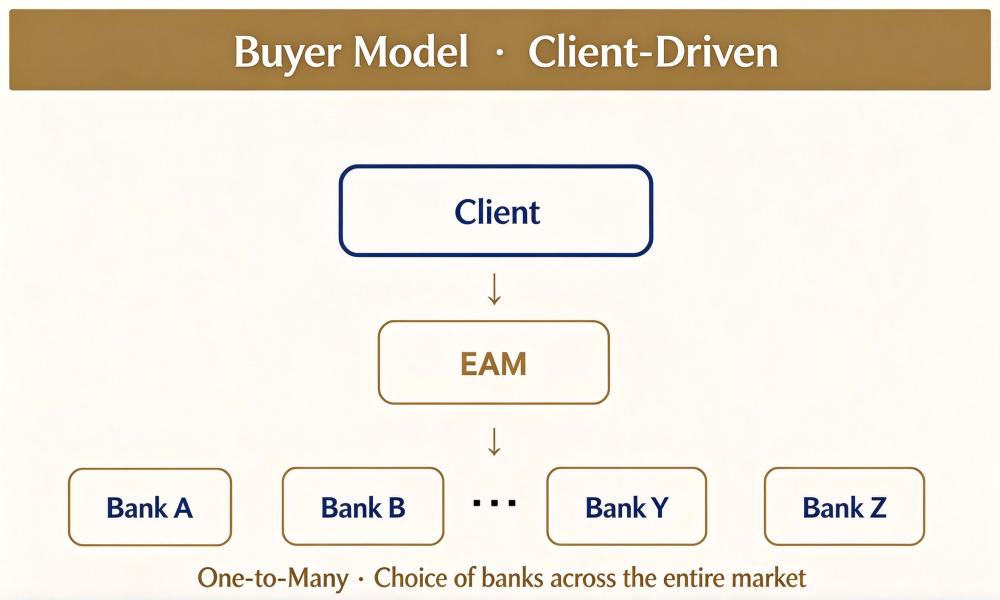
The practical significance of this difference lies in the fact that EAMs can screen across the product pools of multiple custodian banks rather than being confined to a single institution's admission list. For families with accounts at multiple private banks, the unified window service provided by EAMs also helps reduce reconciliation costs and information asymmetry in multi-account management.
The evolution of high-net-worth client demands is the deep-seated driver behind the growing attention to the EAM model. Today's clients are no longer satisfied with being a single institution's "business resource"; they prefer the bank to return to being a professional platform for asset custody and execution.
In the traditional architecture, banks have the dual role of custody and sales, which objectively creates a tendency toward interest alignment. The core value of the EAM model is to provide an independent advisor who stands on the same side as the client, eliminates information asymmetry, and optimizes fee rates. This pursuit of objectivity and coordination efficiency is prompting more clients to make new choices in their wealth architecture.
Applicable Scenarios and Mature Ecosystem
From market practice, the EAM model is particularly suitable for families and individuals with cross-border assets, multiple bank accounts requiring unified management, or concerns about traditional sales models who seek an independent advisory stance. Its focus is on long-term allocation and risk control.

It is worth noting that Hong Kong's EAM ecosystem is already highly mature. Backed by Hong Kong's robust common law system and its status as an international financial center, EAM services have formed highly standardized operations in terms of compliance, professionalism, and global asset allocation capabilities. It is no longer a novel niche attempt, but a market-validated "golden combination" that can perfectly synergize with top-tier private banks. For high-net-worth individuals seeking asset isolation, interest alignment, and cross-border coordination, this clear-cut, mature mechanism is increasingly becoming the preferred option in wealth management architecture.
DISCLAIMER
The information contained in this document has been prepared based on publicly available information. des Voeux Partners Limited ("DVP") in preparing this document, and des Voeux Family Office Limited ("DVFO") in reproducing this document, have taken reasonable care to ensure that the information contained herein is accurate and objective. However, neither DVP nor DVFO makes any representation or warranty as to the accuracy or completeness of the information contained in this document (including any valuation mentioned herein), nor has any independent verification of such information been conducted. DVP makes no representation or warranty as to the adequacy, completeness, or suitability of this document for any particular purpose.This document merely provides a macroeconomic overview of recent economic and market developments and is intended solely for marketing and reference purposes. This document is not an investment research report, nor should it be regarded as investment research. The preparation of this document has not complied with legal requirements intended to promote the independence of investment research, nor is it subject to any prohibition on dealing ahead of the dissemination of investment research. Unless otherwise specified, the source of information contained in this document is DVP. The opinions expressed herein represent the views of the author as of the date of writing and are subject to change at any time without prior notice. Any forecasts, estimates, or targets mentioned in this document are for reference only and are not guaranteed to be achieved. DVP and the author assume no liability for any failure to achieve such forecasts, estimates, or targets. In the event of any discrepancy or inconsistency between the Chinese and English versions of this document, the English version shall prevail.No person should rely solely on the contents of this document to make any investment or other decisions. All relevant decisions should be based on your independent judgment and after consulting appropriate professional advisers.This document does not constitute an offer or invitation to buy or sell any securities, financial instruments, or other investment products by DVP or its affiliates, nor does it constitute any investment, accounting, legal, or tax advice. The contents of this document shall not be regarded as investment advice, an offer, or a solicitation provided to any individual.Investing in any products mentioned in this document involves varying degrees of risk, including credit risk, market risk, liquidity risk, legal risk, cross-jurisdictional risk, foreign exchange risk, and other risks associated with electronic trading and leveraged product trading. Investment inherently carries risk, and you may not recover your full principal amount invested. Prices of investment products may fluctuate significantly, going up or down, and may even become valueless. Buying and selling investment products carries the risk of incurring losses rather than making profits.Nothing in this document constitutes personalized accounting, legal, regulatory, tax, financial, or other professional advice tailored to the personal circumstances of the reader. Before investing in any product, you should consult your own financial, legal, tax, or other professional advisers to fully understand the relevant risks and assess whether you are suited to bear such risks.All descriptions of any investment products herein are subject to the terms and conditions of the respective investment product and, where applicable, the prospectus or other relevant offering documents accompanying such investment product.To the maximum extent permitted by applicable laws and regulations, DVP, DVFO, and their affiliates shall not be liable for any loss or damage of any kind arising from any action taken or not taken by any person in reliance upon any information, opinion, forecast, or valuation contained in this document, regardless of how such loss or damage arises.This document and its contents are intended solely for professional investors as defined in the Securities and Futures (Professional Investor) Rules (Cap. 571D) of Hong Kong. This document and its contents have not been reviewed by the Securities and Futures Commission of Hong Kong (SFC).