


Abstract
The global tax information exchange system is undergoing a significant upgrade. CRS 2.0 (Common Reporting Standard) has incorporated crypto-assets and central bank digital currencies into its reporting scope, while CARF (Crypto-Asset Reporting Framework) establishes a dedicated regulatory framework for crypto-assets. For enterprises and individuals holding cross-border assets, understanding the pace and boundaries of these changes has become an essential requisite for wealth management.
I. The Core Changes of CRS 2.0: Extending to Digital Assets
Since its introduction in 2014, the CRS (Common Reporting Standard) has become the foundational standard for the automatic exchange of financial account information globally. Since 2018, China has completed information exchanges with over 100 countries and jurisdictions. CRS 2.0 is not merely a technical patch; the revised version released by the OECD (Organisation for Economic Co-operation and Development) in 2023 includes specified electronic money products, central bank digital currencies, and crypto-asset derivatives into the reporting system. Cross-border allocation methods that previously relied on digital wallets will now face greater transparency. Meanwhile, due diligence standards have been tightened; financial institutions are required to cross-verify client self-certifications and mandatorily collect Tax Identification Numbers (TINs). Accounts with incomplete or questionable information may face restrictions or remediation requirements.
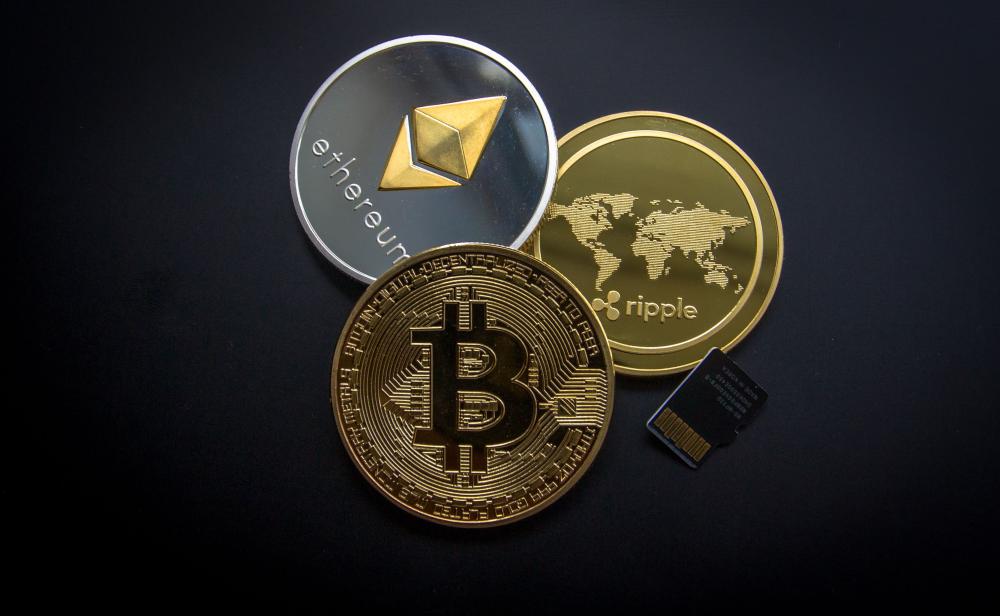
II. CARF: The Dedicated Regulatory Framework for Crypto-Assets
The CARF (Crypto-Asset Reporting Framework) is an information exchange standard tailored specifically for crypto-assets. Its reporting entities include cryptocurrency exchanges, custodian wallet providers, and brokers. Reportable transactions include exchanges between fiat currencies and crypto-assets, exchanges between different crypto-assets, and cross-platform or cross-wallet transfers. Service providers must collect users' tax residency status and TINs to ensure that each transaction corresponds to a specific taxpayer.
III. Hong Kong's Implementation Pace: A Phased Approach
Hong Kong maintains a proactive pace in implementing OECD standards. According to officially announced arrangements:
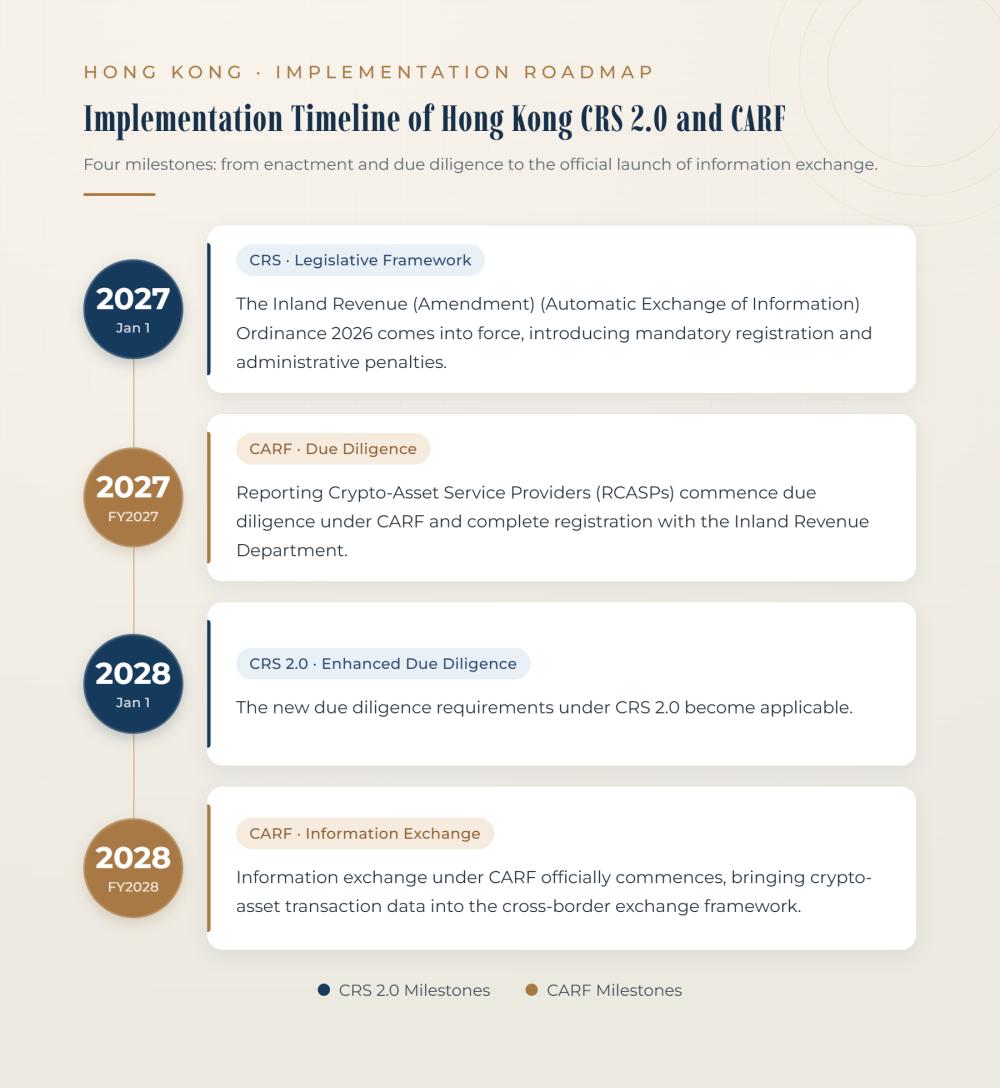
Note: The following arrangements are premised on the passage of the Inland Revenue (Amendment) (Automatic Exchange of Information) Ordinance 2026 [CRS administrative framework, gazetted on 26 June 2026] and the Inland Revenue (Amendment) (Crypto-Asset Reporting Framework and Amended Common Reporting Standard) Bill 2026 [CARF + CRS 2.0, gazetted on 22 May 2026] by the Legislative Council.
IV. Asset Boundaries Worth Noting
Not all assets automatically fall within the scope of exchange. Under current rules, overseas bank accounts, securities holdings, cash-value insurance policies, beneficial ownership information of offshore trusts, and crypto-asset transaction data from 2028 onwards will be subject to exchange. Conversely, overseas physical real estate, gold and jewelry, artworks, and non-listed company equity directly held by individuals are currently not subject to direct exchange.

The look-through rules for offshore trusts are particularly noteworthy. Due to the relatively high proportion of passive income, the majority of family trusts may be classified as "Passive Non-Financial Entities (PNFEs)," requiring the identification and reporting of information regarding the settlor, beneficiaries, and controlling persons. On 24 July 2026, the Ministry of Finance and the State Taxation Administration of China jointly issued the Announcement on Matters Concerning Individual Income Tax on Offshore Trusts (Ministry of Finance and State Taxation Administration Announcement No. 21 of 2026), further clarifying the regulatory framework for "look-through" taxation.
V. Grasping the Compliance Rhythm: From Understanding to Orderly Arrangements
The implementation of CRS 2.0 and CARF is a gradual process, and Hong Kong's phased arrangements provide the market with a window for adaptation. At the practical level, it is recommended to prioritize reviewing the reporting obligations of existing cross-border structures, confirming the consistency of tax residency status, and completing information such as TINs.
For investors involved in crypto-asset allocations, understanding the scope of reporting obligations for service providers under CARF will help assess the information visibility of their own assets.
The direction of global tax transparency is relatively clear, but differences and transitional arrangements still exist in the implementation details across various jurisdictions. In this broader context, maintaining continuous attention to regulatory changes may be more pragmatic than rushing into major adjustments.
DISCLAIMER
The information contained in this document has been prepared based on publicly available information. des Voeux Partners Limited ("DVP") in preparing this document, and des Voeux Family Office Limited ("DVFO") in reproducing this document, have taken reasonable care to ensure that the information contained herein is accurate and objective. However, neither DVP nor DVFO makes any representation or warranty as to the accuracy or completeness of the information contained in this document (including any valuation mentioned herein), nor has any independent verification of such information been conducted. DVP makes no representation or warranty as to the adequacy, completeness, or suitability of this document for any particular purpose.This document merely provides a macroeconomic overview of recent economic and market developments and is intended solely for marketing and reference purposes. This document is not an investment research report, nor should it be regarded as investment research. The preparation of this document has not complied with legal requirements intended to promote the independence of investment research, nor is it subject to any prohibition on dealing ahead of the dissemination of investment research. Unless otherwise specified, the source of information contained in this document is DVP. The opinions expressed herein represent the views of the author as of the date of writing and are subject to change at any time without prior notice. Any forecasts, estimates, or targets mentioned in this document are for reference only and are not guaranteed to be achieved. DVP and the author assume no liability for any failure to achieve such forecasts, estimates, or targets. In the event of any discrepancy or inconsistency between the Chinese and English versions of this document, the English version shall prevail.No person should rely solely on the contents of this document to make any investment or other decisions. All relevant decisions should be based on your independent judgment and after consulting appropriate professional advisers.This document does not constitute an offer or invitation to buy or sell any securities, financial instruments, or other investment products by DVP or its affiliates, nor does it constitute any investment, accounting, legal, or tax advice. The contents of this document shall not be regarded as investment advice, an offer, or a solicitation provided to any individual.Investing in any products mentioned in this document involves varying degrees of risk, including credit risk, market risk, liquidity risk, legal risk, cross-jurisdictional risk, foreign exchange risk, and other risks associated with electronic trading and leveraged product trading. Investment inherently carries risk, and you may not recover your full principal amount invested. Prices of investment products may fluctuate significantly, going up or down, and may even become valueless. Buying and selling investment products carries the risk of incurring losses rather than making profits.Nothing in this document constitutes personalized accounting, legal, regulatory, tax, financial, or other professional advice tailored to the personal circumstances of the reader. Before investing in any product, you should consult your own financial, legal, tax, or other professional advisers to fully understand the relevant risks and assess whether you are suited to bear such risks.All descriptions of any investment products herein are subject to the terms and conditions of the respective investment product and, where applicable, the prospectus or other relevant offering documents accompanying such investment product.To the maximum extent permitted by applicable laws and regulations, DVP, DVFO, and their affiliates shall not be liable for any loss or damage of any kind arising from any action taken or not taken by any person in reliance upon any information, opinion, forecast, or valuation contained in this document, regardless of how such loss or damage arises.This document and its contents are intended solely for professional investors as defined in the Securities and Futures (Professional Investor) Rules (Cap. 571D) of Hong Kong. This document and its contents have not been reviewed by the Securities and Futures Commission of Hong Kong (SFC).
- Previous: The NDRC's Updated "Measures for the Administration of Outbound Investment": How Will It Reshape Chinese Families' Overseas Assets?2026-10-26
- Next: des Voeux Insights | Brain-Computer Interfaces Accelerate Towards Commercialization: Decoding a Trillion-Dollar Investment Blue Ocean in Healthcare2026-10-21