

The message conveyed by these figures is clear: the vast majority of taxpayers holding offshore trusts have completed their tax declarations and payments. Those still waiting on the sidelines are becoming a minority.
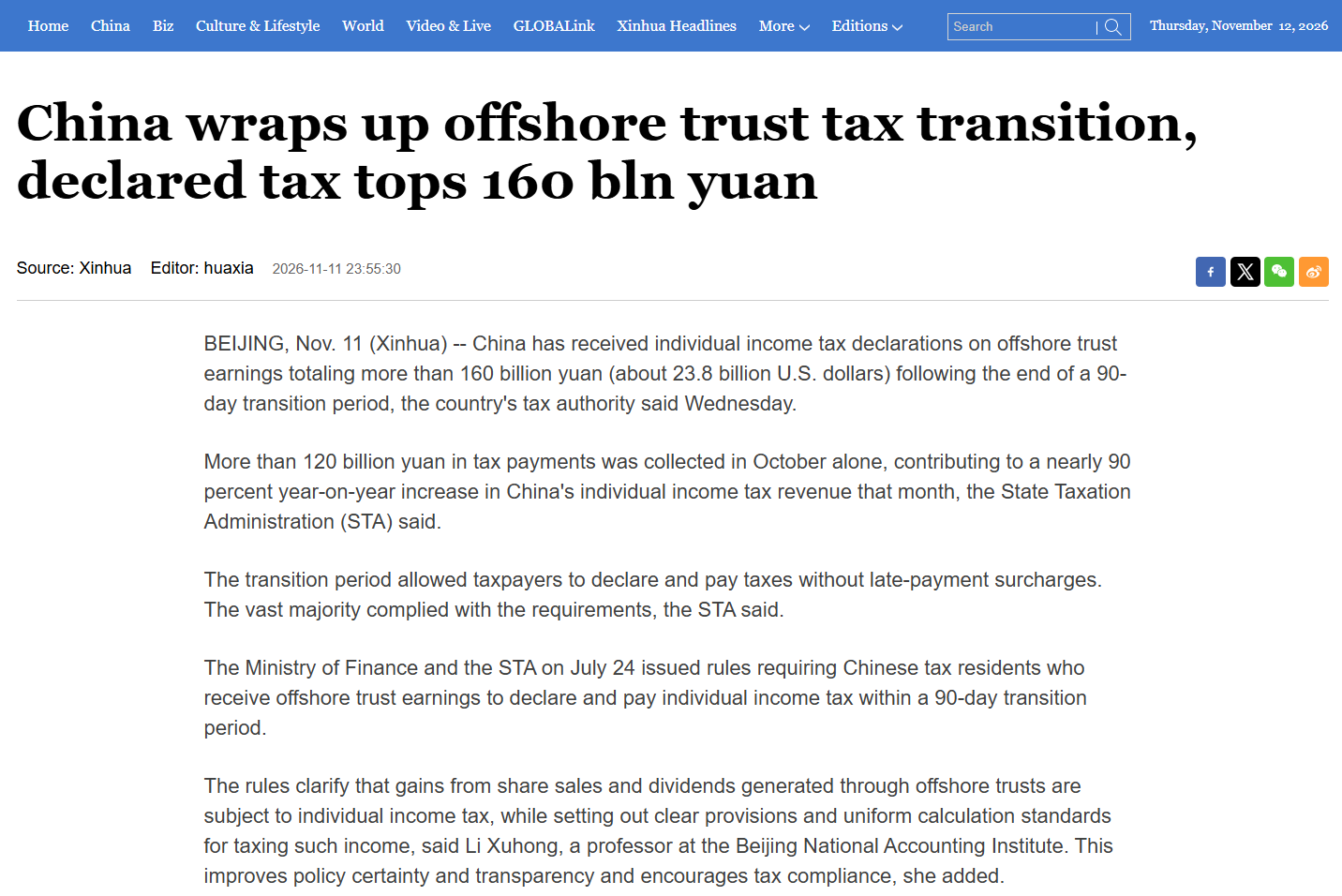
Note: Data source is the State Taxation Administration, disclosed via Xinhua News Agency and other official channels on November 11, 2026.
I. The Official Next Step: Late Fees, Audits, and Public Exposure
A relevant official from the STA's Income Tax Department made a clear statement: for taxpayers who have made false declarations or failed to proactively declare after the transition period ended, tax authorities will urge them to declare and pay taxes in accordance with the law, and will impose late payment fees as stipulated. For those who still fail to declare or make false declarations after being urged, authorities will initiate formal audits and other measures in accordance with the law. In severe cases, public exposure will be applied. At the same time, illegal intermediary agencies and individuals who induce or assist taxpayers in tax evasion will also be seriously investigated and dealt with according to laws and regulations.
This means that after the transition period ended on October 22, the matter is far from "closed." The compliance window is shifting from "proactive declaration without late fees" to a phase of "passive response potentially facing late fees and audits."
Note: The policy basis for the transition period is the "Announcement on Matters Concerning Individual Income Tax on Offshore Trusts" (Ministry of Finance and State Taxation Administration Announcement No. 21 of 2026), which stipulates that no late payment fees will be imposed for declarations and payments completed within the 90-day transition period.
II. A Reality That Those Still Waiting Must Confront
Over the past few months, many families holding offshore trusts have been in a "wait-and-see" mode: waiting for enforcement intensity to become clearer, waiting for others to move first, waiting for the market to give a clearer signal.
The RMB 160 billion declaration figure provides the answer. When the vast majority of taxpayers have already completed their declarations, undeclared accounts will stand out more prominently in the tax system. The STA's statement also indicates that future enforcement resources will be concentrated on the few non-compliant cases, rather than continuing to provide a universally available grace window.
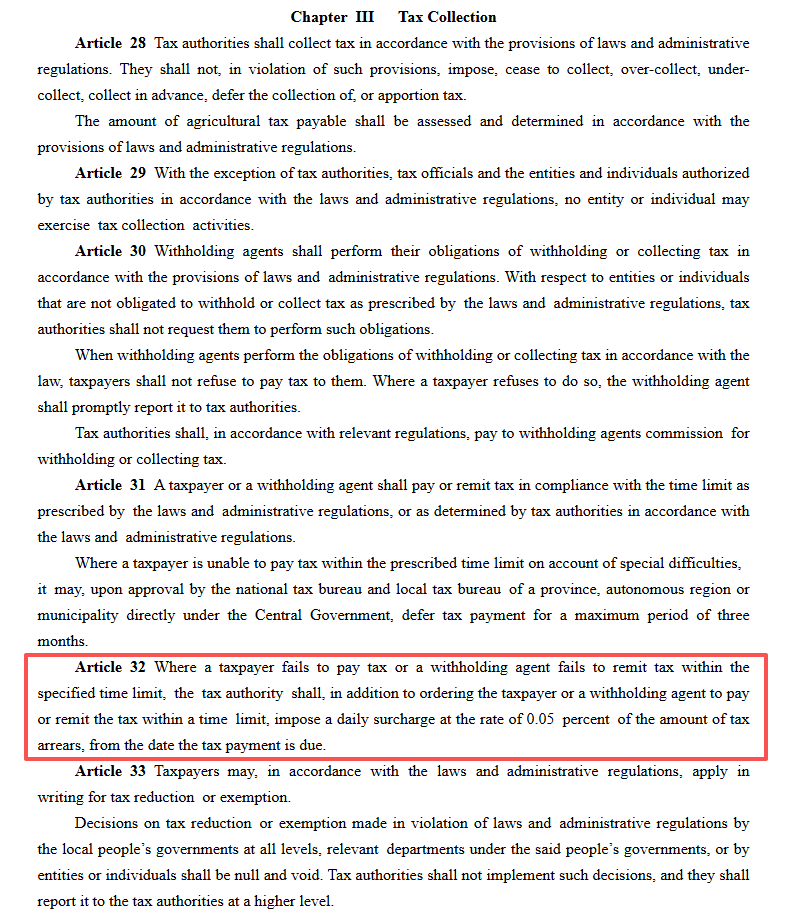
For families, this means that "waiting" itself is becoming a choice with costs. Late payment fees accrue daily, audits bring time and compliance costs, and the potential risk of public exposure are all variables that need to be factored into consideration.
Note: The standards for late payment fees on overdue tax payments are executed in accordance with Article 32 of the "Law of the People's Republic of China on the Administration of Tax Collection."
The efficiency of this tax supplementation itself is a signal worth noting. From the announcement in July to the end of the transition period in October, over RMB 160 billion in tax revenue was collected within just three months. This demonstrates that tax authorities' grasp of offshore trust-related information, as well as the response capacity of the tax administration system, have far exceeded market expectations.
Combined with the formal implementation of CRS 2.0 new standards in the BVI and the Cayman Islands on January 1, 2026, and Hong Kong's ongoing legislative amendment procedures, information on the underlying assets and beneficiaries of offshore trusts is entering a more efficient and transparent exchange cycle.
Tax supplementation is only the first step. Subsequent annual declarations, structural compliance reviews, and substantive activity requirements will all become routine matters that offshore trust holders must continuously address. The space for "information asymmetry" is being systematically narrowed.

Conclusion
The RMB 160 billion declaration figure is both a full stop for the end of the transition period and a starting point for a new regulatory cycle. For families holding offshore trusts, the real question that needs to be answered has shifted from "whether to declare" to "whether the structure can withstand continuous compliance scrutiny."
Changes in rules do not yield to individual will. Understanding the trend, facing reality, and completing necessary reviews and adjustments within a professional framework is more pragmatic than waiting for a "better time."
DISCLAIMER
The information contained in this document has been prepared based on publicly available information. des Voeux Partners Limited ("DVP") in preparing this document, and des Voeux Family Office Limited ("DVFO") in reproducing this document, have taken reasonable care to ensure that the information contained herein is accurate and objective. However, neither DVP nor DVFO makes any representation or warranty as to the accuracy or completeness of the information contained in this document (including any valuation mentioned herein), nor has any independent verification of such information been conducted. DVP makes no representation or warranty as to the adequacy, completeness, or suitability of this document for any particular purpose.This document merely provides a macroeconomic overview of recent economic and market developments and is intended solely for marketing and reference purposes. This document is not an investment research report, nor should it be regarded as investment research. The preparation of this document has not complied with legal requirements intended to promote the independence of investment research, nor is it subject to any prohibition on dealing ahead of the dissemination of investment research. Unless otherwise specified, the source of information contained in this document is DVP. The opinions expressed herein represent the views of the author as of the date of writing and are subject to change at any time without prior notice. Any forecasts, estimates, or targets mentioned in this document are for reference only and are not guaranteed to be achieved. DVP and the author assume no liability for any failure to achieve such forecasts, estimates, or targets. In the event of any discrepancy or inconsistency between the Chinese and English versions of this document, the English version shall prevail.No person should rely solely on the contents of this document to make any investment or other decisions. All relevant decisions should be based on your independent judgment and after consulting appropriate professional advisers.This document does not constitute an offer or invitation to buy or sell any securities, financial instruments, or other investment products by DVP or its affiliates, nor does it constitute any investment, accounting, legal, or tax advice. The contents of this document shall not be regarded as investment advice, an offer, or a solicitation provided to any individual.Investing in any products mentioned in this document involves varying degrees of risk, including credit risk, market risk, liquidity risk, legal risk, cross-jurisdictional risk, foreign exchange risk, and other risks associated with electronic trading and leveraged product trading. Investment inherently carries risk, and you may not recover your full principal amount invested. Prices of investment products may fluctuate significantly, going up or down, and may even become valueless. Buying and selling investment products carries the risk of incurring losses rather than making profits.Nothing in this document constitutes personalized accounting, legal, regulatory, tax, financial, or other professional advice tailored to the personal circumstances of the reader. Before investing in any product, you should consult your own financial, legal, tax, or other professional advisers to fully understand the relevant risks and assess whether you are suited to bear such risks.All descriptions of any investment products herein are subject to the terms and conditions of the respective investment product and, where applicable, the prospectus or other relevant offering documents accompanying such investment product.To the maximum extent permitted by applicable laws and regulations, DVP, DVFO, and their affiliates shall not be liable for any loss or damage of any kind arising from any action taken or not taken by any person in reliance upon any information, opinion, forecast, or valuation contained in this document, regardless of how such loss or damage arises.This document and its contents are intended solely for professional investors as defined in the Securities and Futures (Professional Investor) Rules (Cap. 571D) of Hong Kong. This document and its contents have not been reviewed by the Securities and Futures Commission of Hong Kong (SFC).